
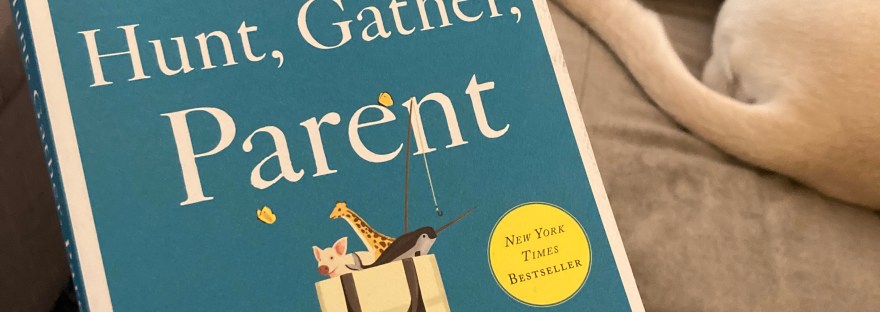
I first heard about this parenting book, written by Dr. Michaeleen Doucleff, from an Instagram account that I really respect. When I learned that the author lived with and studied the oldest cultures in the world in order to understand how they raise their children to be happy, helpful humans, I was even more intrigued. Not only did Doucleff, an NPR correspondent, interview parents and observe them with their own families, she also got to witness their particular brand of magic with her own rambunctious 5-year-old, with whom Doucleff was honest about having some struggles.
I have to say, never has a parenting book taken me on such a roller coaster before! There are many aspects of Hunt, Gather, Parent that I really love and have taken to heart for my personal journey in parenthood, as well as plan to incorporate into my professional work with other parents. However, there are also aspects of this book that I very strongly disagree with, to the point that I nearly abandoned the book without finishing it.
But what kept me picking it up, possibly even more than the sections I loved, were the sections that made me go…huh. Things that made me question what I thought I knew (or how I felt) about communicating with children. I wouldn’t say I abandoned my own knowledge and experience in favor of Doucleff’s findings – but a book that surprises you and gets you thinking more deeply about your views is a book well-worth continuing.
I’ve decided to break down my review into the same categories that I experienced Doucleff’s book: the good, the bad, and the head-scratching!
The Good
Despite my slightly dramatic introduction there, my view of Hunt, Gather, Parent is overwhelmingly positive. I agree so much with a lot of what Doucleff says: children do not need a million activities, perfect wooden toys, or 24/7 parental supervision in order to turn out as kind, well-adjusted people. Western parents put a ton of pressure on themselves to do things perfectly and lose sight of just “being with,” which is a struggle that parents from Maya, Inuit, and Hadzabe families don’t seem to share.
By far my favorite section of the book was a chapter on how to raise children to be helpers. Doucleff described how Mayan families involved kids in completing household tasks – practically from birth. Non-mobile infants are brought close to watch their parents work, and as the babies’ life skills increase, so does their involvement in helping. Once little ones are able to follow simple directions, they’re asked to throw away trash, fold a small towel, or roll a little ball of tortilla dough.
As Doucleff says (and I agree), toddlers have a natural urge to help. They want to be with us, and do what we do. Rather than shooing them off to play as we tend to in the U.S., the Mayans lean into this urge. That means anytime a child requests to help with something – even something seemingly “dangerous,” if safe modifications can be made – their assistance is whole-heartedly accepted. Every time.
Furthermore, Mayan parents don’t praise their children for these acts. They don’t say, “Good job!” or “What a big helper!” Instead, they acknowledge their little ones’ contributions by fully accepting the job the way it was done and not re-doing it for them.
That may not sound ground-breaking yet, but take a moment to imagine what a 2-year-old’s help probably looks like. After sweeping, there’s likely still plenty of dirt left behind. A towel they’re handed to fold probably gets balled up. The little piece of dough is perhaps squished into smithereens. But rather than coming behind their children and doing the task “correctly,” Mayan families accept it the way it is, as long as a child puts their best effort in.
Children see their contributions appreciated and valued from the very start.
I was genuinely stunned by that advice, and it alone made the whole book worth it for me. But there are PLENTY of other strong sections in addition to this, including:
- Inuit parents’ emphasis on helping kids learn to control their anger through nurturance (p. 144)
- Equating kids learning proper behavior to learning math: we don’t get angry at them for not knowing 2+2 before they’re ready, so why do we get mad about misbehavior? (p 154)
- Doucleff’s suggestion to audio record a morning with your kids and listen to it, taking note of how many commands you give, how well you listen to them, and so on (p 197)
- Hadzabe families prioritizing kids’ autonomy by letting them make their own decisions and mistakes and holding off (“waiting a bit”) before they instruct, direct, or issue a command (p 257-264)
The Bad
After reading the chapter on raising helpers, I was HOOKED on Hunt, Gather, Parent. I felt like Doucleff had unlocked some secret code to parenting, and I was prepared to follow every piece of advice that came after it. Alas, things took a weird turn.
While studying the Maya families, Doucleff observed family members hanging out together differently than we do in the west. There, parents and children spend a ton of time together going about their daily business with cooking, cleaning, and caring for babies. The families did not, however, pass their weekends attending kids’ birthday parties, going to children’s museums, or playing child-friendly board games together. Little ones were free to play with toys and puzzles on their own, but parents did not join them. The Maya children certainly weren’t suffering for it, and were quite content to be with their parents in other ways.
The startling part for me was not how Maya families pass their time together, but on Doucleff’s hot take from her experience. She concluded that modern Western families should eschew ALL “child-centered activities” – or at least avoid as many as humanly possible. (In this context, child-centered was defined as any activity that parents do for the joy of their children, but wouldn’t do without kids present. Ergo, if you would attend a friend’s child’s birthday party of your own accord, then it’s not considered child-centered, but it is if you wouldn’t be caught dead there unless you were bringing a kid along. Doucleff does acknowledge that this will look different for every parent.)
Her opinion doesn’t stop short at birthday parties though. She recommends steering clear of other child-focused activities as well, including:
- Board games
- Crafts
- Zoos, aquariums
- Children’s museums or learning centers
- Pretend play
- Visits to playgrounds
- Buying any new toys
Make it a goal to say no to as many birthday parties, zoo trips, playdates, and ‘enrichment outings’ as possible. – Doucleff, p92
In case you’re new to my blog or page, let me back up a little and explain why the idea of being so against child-centered activities is a hot-button issue for me. As a play therapist, I know that children use play to process their experiences and learn new things about their world. They use it to connect. When parents come to me in frustration because they’re constantly in conflict with their child, I always recommend squeezing in some playtime – and I even emphasize the importance of making it “child led.” Play builds trust and safety. It repairs relationship wounds. And it gives you a very valuable window into your child’s underlying needs and feelings.
Know this: I absolutely do NOT think every day or every weekend should revolve around kids’ desires. If you hate birthday parties and never want to attend one again, that’s your prerogative – and I may even join you in that! I also agree that children truly don’t need to be entertained around the clock – we do them a misfortune when we schedule every minute. Free time (and a little boredom) is essential.
But the idea of throwing out any activity simply because it’s not a parent’s preference… is bizarre to me. Kids don’t become entitled nor immature because their parents play with them.
There are a couple other stinkers in this book (including rather outdated and eye-roll-inducing advice to call children “babies” when they don’t do a task properly), but this one alone led to me nearly quitting the read completely.
The Head-Scratching
Okay, we’re finally to the section that made go “Whoa.” To back up again, in my practice as a child-centered play therapist, I firmly believe in not doing tasks for children that I believe they can do themselves, even if I’m asked. I often recommend this to parents for use at home as well. Why? Children develop confidence through competence. If we offer assistance every time they encounter a little (age-appropriate) challenge, we’re only reinforcing the idea that they can’t do it on their own.
On the other hand, Maya parents, according to Doucleff, always help children when they ask for it – yes, even when the child is perfectly capable of doing the task alone! Their reasoning is that if we want kids to help when WE ask for it, we must model the same. The fact that we can technically do the task on our own isn’t the point. Family members pitching in to support each other is the point.
This was obviously a complete 180 from what I believed, but it was such a fascinating point that I wasn’t going to dismiss it. So I sat with this notion for awhile. I thought about how I feel when I struggle to do something alone and need support. I admitted to myself that if I’ve managed to ask for help and someone turns me down, that doesn’t feel great. Going on to successfully complete the task on my own might lift my sense of independence a little, but it also feels aggravating and… kind of lonely.
Ultimately, I don’t think either side is wholly correct, they’re just striving for different goals! Encouraging kids to do things on their own builds independence, and stepping in to help builds a sense of community. It’s up to each parent to decide which is more important to them – and it may fluctuate depending on the situation.
To sum up: I think Hunt, Gather, Parent has some truly amazing concepts and ideas. I also think it wildly overcorrects sometimes. It’s the equivalent of noticing that your car is veering slightly into another lane, so you dramatically wrench the wheel in the opposite direction. I recommend reading it with an open mind, but as always, use what makes sense to you and leave behind what doesn’t!

 Amanda Robinson, LPC-S, RPT-S
Thank you for sharing such an insightful e-book review! Your thoughtful analysis no longer only highlights the key points of ‘Hunt, Gather, Parent’ but also offers precious insights into modern parenting dynamics. Your engaging writing style makes it a pleasure to read and leaves us eager to discover the book further. Keep up the excellent work in supplying valuable resources and views for parents navigating the challenges of raising young people in today’s world.
LikeLike